
O2 Sensor Failure Symptoms and Replacement Cost: How to Tell Whether the Sensor Is Actually Bad
O2 Sensor Failure Symptoms and Replacement Cost: How to Tell Whether the Sensor Is Actually Bad
An oxygen sensor is a relatively small component, but it can influence fuel economy, engine performance, emissions, and catalytic-converter operation.
When an O2 sensor begins failing, the first sign may be a check engine light. Other vehicles develop rough idling, hesitation, increased fuel consumption, failed emissions testing, or unusual exhaust behavior. In some cases, there may be no noticeable drivability symptoms at all.
That does not mean every oxygen-sensor trouble code requires a new sensor.
The sensor may be accurately reporting a problem caused by a vacuum leak, leaking fuel injector, exhaust leak, ignition misfire, low fuel pressure, wiring failure, engine oil consumption, coolant entering the combustion chamber, or a deteriorating catalytic converter. Replacing the sensor without testing the rest of the system may turn off the light temporarily—or may accomplish nothing.
As of June 2026, RepairPal’s national estimate places the average cost of an oxygen sensor replacement at $454 to $551, including an estimated $92 to $135 in labor and $362 to $416 in parts. The estimate excludes taxes, fees, location differences, diagnostic charges, and related repairs. Older or readily accessible sensors may cost less, while wideband air-fuel sensors, difficult locations, seized threads, and specialty applications may cost considerably more.
O2 Sensor Symptoms at a Glance
| Symptom | Possible connection to the oxygen sensor | Other common possibilities |
| Check engine light | Sensor signal, heater, response, or circuit fault | Vacuum leak, exhaust leak, wiring, fuel delivery, catalyst, misfire |
| Reduced fuel economy | Incorrect air-fuel feedback may cause unnecessary fuel correction | Tire pressure, driving conditions, injectors, MAF sensor, thermostat |
| Rough idle | Incorrect fuel correction can destabilize combustion | Vacuum leak, ignition misfire, injector problem, low compression |
| Hesitation or sluggish acceleration | Fuel mixture may not respond properly | Fuel-pressure problem, ignition fault, airflow sensor, transmission issue |
| Failed emissions test | O2 monitor fault or increased exhaust emissions | Catalytic converter, EVAP fault, misfire, readiness monitors |
| Black exhaust smoke | Engine may be operating excessively rich | Leaking injector, high fuel pressure, restricted air intake, sensor fault |
| Sulfur or rotten-egg odor | Rich operation may overload the catalytic converter | Catalyst failure, misfire, fuel-system fault |
| Engine surging | Fuel control may repeatedly overcorrect | Vacuum leak, throttle problem, fuel delivery, ignition fault |
| Stalling | Severe fuel-control error may contribute | Air leak, idle control, crank sensor, fuel pressure, charging problem |
| Catalytic-converter code | Downstream sensor may detect poor catalyst performance | Converter deterioration, exhaust leak, misfire, incorrect fueling |
| No obvious symptoms | Some sensor and heater faults do not noticeably affect driving | The vehicle may still store codes and increase emissions |
These symptoms overlap with many other vehicle problems. No single symptom proves that an oxygen sensor needs replacement.
What Does an Oxygen Sensor Do?
An oxygen sensor measures the oxygen remaining in a vehicle’s exhaust and sends that information to the engine control module. The computer combines the reading with data from other sensors to adjust fuel delivery and support efficient catalytic-converter operation.
Gasoline engines often operate near a 14.7:1 air-fuel ratio, although the mixture changes during cold starts, acceleration, heavy loads, and other conditions. The oxygen sensor does not control the injectors or measure fuel level or octane; it only provides information that the computer uses to manage the engine.
Upstream vs. Downstream Oxygen Sensors
Most modern gasoline vehicles use multiple oxygen sensors. The upstream sensor, located before the catalytic converter, plays a major role in fuel-mixture control. When it fails, it may contribute to poor fuel economy, rough idle, hesitation, incorrect fuel trims, sluggish acceleration, or rich or lean operation.
The downstream sensor is located after the catalytic converter and primarily monitors catalyst performance. A failure may trigger the check engine light, prevent emissions monitors from completing, or produce inaccurate catalyst data. The computer compares upstream and downstream readings to determine whether the catalytic converter is operating properly.
Cassels Garage’s exhaust repair and catalytic-converter service includes inspection of exhaust pipes, catalytic converters, seals, connections, related sensors, and emissions components. An exhaust-system evaluation is important when a sensor code appears alongside noise, leaks, catalyst codes, or unusual exhaust behavior.
The Most Common O2 Sensor Failure Symptoms
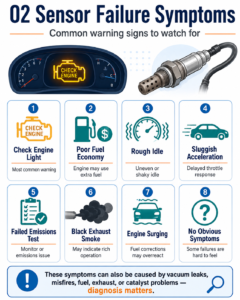
Check Engine Light
The check engine light is the most common warning associated with oxygen-sensor failure.
The onboard diagnostic system may detect:
- Signal voltage outside the expected range
- Slow sensor response
- No sensor activity
- Heater-circuit fault
- Implausible air-fuel data
- Signal stuck rich or lean
- Wiring or reference problem
- Sensor readings inconsistent with another component
Cassels Garage’s check engine light service begins by retrieving stored trouble codes and evaluating the systems connected to those codes. Cassels notes that emissions faults, engine misfires, catalytic converter problems, and other engine conditions can all illuminate the warning, not only a defective sensor.
A steady light usually indicates the vehicle has detected a fault that requires diagnosis. A flashing check engine light commonly indicates a severe misfire that can overheat and damage the catalytic converter. U.S. Environmental Protection Agency (EPA) guidance warns that continued operation during a serious flashing-light condition can cause major damage, particularly to the converter.
Poor Fuel Economy
A deteriorated upstream sensor may respond slowly, report inaccurate information, or cause the computer to rely on substitute values.
The engine may then use more fuel than necessary.
Fuel economy can also decline because of:
- Low tire pressure
- Cold weather
- Short trips
- Extended idling
- Aggressive driving
- Dirty air filter
- Faulty thermostat
- Leaking injector
- Mass-airflow sensor contamination
- Ignition misfire
- Brake drag
A change in fuel economy should be evaluated along with fuel-trim data, sensor response, operating temperature, and mechanical condition.
Bosch lists reduced fuel economy among the symptoms that can justify diagnosing and replacing the oxygen sensor when supported by fault codes and testing.
Rough Idle
A failing upstream sensor can contribute to unstable fuel correction, especially after the engine enters closed-loop operation.
The idle may feel:
- Uneven
- Shaky
- Too low
- Surging
- Close to stalling
However, rough idle is more commonly shared with faults such as:
- Vacuum leak
- PCV-system failure
- Dirty throttle body
- Ignition-coil failure
- Worn spark plugs
- Injector imbalance
- Low compression
- EGR fault
- Engine-mount wear
- Fuel-pressure problem
Cassels Garage’s engine repair and diagnostic service evaluates ignition, fuel delivery, electrical systems, cooling problems, sensors, and mechanical engine conditions when a vehicle idles roughly, loses power, stalls, or develops a warning light.
Hesitation or Sluggish Acceleration
Incorrect fuel feedback may cause hesitation when the accelerator is pressed.
The driver may notice:
- Delayed response
- Flat spot
- Surging
- Reduced power
- Jerking
- Difficulty merging or climbing hills
An oxygen sensor is only one possibility. Airflow measurement, fuel pressure, turbocharger operation, ignition, transmission behavior, exhaust restriction, and throttle control may produce similar symptoms.
Bosch lists sluggish acceleration as a possible symptom of a sensor that should be tested and replaced if the diagnosis confirms failure.
Engine Surging
A slow or biased sensor can cause fuel control to overcorrect.
The computer may add fuel after seeing a lean signal, then remove fuel when the exhaust appears rich. If the feedback is delayed or inaccurate, the corrections can become unstable.
Surging may also result from:
- Intake leak
- Fuel-pressure fluctuation
- Throttle problem
- EGR malfunction
- Ignition fault
- Transmission issue
- Incorrect load signal
- Accelerator-pedal sensor fault
Live data is necessary to see whether oxygen-sensor activity and fuel-trim changes match the driver’s complaint.
Stalling
A failing oxygen sensor usually does not cause immediate engine shutdown by itself. Severe mixture errors can contribute to stalling, but the complete system should be tested.
Other common stalling causes include:
- Crankshaft-position sensor
- Camshaft-position sensor
- Fuel-pump failure
- Low fuel pressure
- Vacuum leak
- Electronic throttle fault
- Idle-control problem
- Charging-system failure
- Immobilizer issue
- Wiring or ground fault
Replacing an O2 sensor solely because a stalling vehicle stored a mixture-related code can miss the actual failure.
Black Exhaust Smoke
Black smoke usually indicates that the engine is burning an excessively rich mixture.
A sensor falsely reporting lean exhaust could cause the computer to add fuel. However, rich operation may also be caused by:
- Leaking injector
- Excessive fuel pressure
- Failed coolant-temperature sensor
- Restricted air intake
- Faulty mass-airflow sensor
- Evaporative purge problem
- Ignition misfire
- Engine-computer fault
The source of rich operation should be corrected before it damages the oxygen sensors or catalytic converter.
Failed Emissions Test
An O2 sensor problem may cause an emissions-test failure because:
- The check engine light is illuminated.
- An oxygen-sensor monitor has not been completed.
- A sensor or heater code is stored.
- The mixture is producing excessive emissions.
- The catalytic-converter monitor cannot run accurately.
Clearing codes immediately before an emissions test is not a reliable solution. It resets readiness monitors, which may cause the vehicle to fail because the onboard tests have not completed.
The underlying fault must be repaired, codes cleared when appropriate, and the vehicle driven through the conditions required to complete its monitors.
Unusual Exhaust Odor
A failing fuel-control sensor may contribute to rich operation that overloads the catalytic converter. Drivers sometimes describe a sulfur-like or rotten-egg odor.
That odor does not specifically identify an oxygen sensor.
Possible causes include:
- Rich fuel mixture
- Ignition misfire
- Failing catalytic converter
- Fuel contamination
- Injector fault
- Engine mechanical problem
Exhaust odors entering the passenger compartment require immediate attention because an exhaust leak may expose occupants to dangerous gases.
Can an O2 Sensor Fail Without Noticeable Symptoms?
Yes.
Some failures primarily affect emissions monitoring rather than immediate drivability.
For example, a downstream sensor or heater circuit may fail while the engine continues to start, idle, and accelerate normally. The driver may notice only the check engine light.
A slow upstream sensor may also degrade gradually. The vehicle computer can compensate enough that the driver adjusts to the change without recognizing it.
The absence of obvious symptoms does not mean the code should be ignored. The system may be consuming more fuel, producing more emissions, or losing its ability to properly monitor the catalytic converter.
Common O2 Sensor Trouble Codes
Oxygen-sensor-related codes commonly appear in the P0130–P0167 range, although vehicle-specific and wideband-sensor codes may use other numbers.
Examples include:
| Code | General description |
| P0130 | O2 sensor circuit malfunction, Bank 1 Sensor 1 |
| P0131 | O2 sensor circuit low voltage |
| P0132 | O2 sensor circuit high voltage |
| P0133 | O2 sensor circuit slow response |
| P0134 | No O2 sensor activity detected |
| P0135 | O2 sensor heater circuit malfunction |
| P0136 | O2 sensor circuit malfunction, Bank 1 Sensor 2 |
| P0140 | No activity detected, Bank 1 Sensor 2 |
| P0141 | Heater circuit malfunction, Bank 1 Sensor 2 |
| P0150 | O2 sensor circuit malfunction, Bank 2 Sensor 1 |
| P0153 | Slow response, Bank 2 Sensor 1 |
| P0155 | Heater circuit malfunction, Bank 2 Sensor 1 |
| P0156 | O2 sensor circuit malfunction, Bank 2 Sensor 2 |
| P0161 | Heater circuit malfunction, Bank 2 Sensor 2 |
| P0171 | System too lean, Bank 1 |
| P0172 | System too rich, Bank 1 |
| P0174 | System too lean, Bank 2 |
| P0175 | System too rich, Bank 2 |
| P0420 | Catalyst efficiency below threshold, Bank 1 |
| P0430 | Catalyst efficiency below threshold, Bank 2 |
The wording can vary by manufacturer.
More importantly, the code describes the condition the computer observed. It does not necessarily identify the component that caused it.
A P0171 lean code may be produced when the oxygen sensor correctly detects excess oxygen caused by an intake leak. DENSO documents an example in which lean codes were returned after an air-fuel sensor had been replaced because the actual cause was a cracked purge-system hose that created a vacuum leak.
How Much Does O2 Sensor Replacement Cost in 2026?
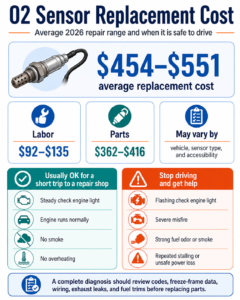
RepairPal’s June 2026 national estimate places oxygen-sensor replacement between $454 and $551 on average:
- Estimated labor: $92-$135
- Estimated parts: $362-$416
- Taxes and fees: Not included
- Diagnostic testing: May be additional
- Related repairs: Not included
That average includes vehicles using expensive wideband sensors and does not mean every repair will cost at least $454.
A straightforward narrowband sensor on an older vehicle may cost less. A difficult sensor on a European, performance, truck, or luxury application can cost more.
Can You Drive With a Bad O2 Sensor?
A vehicle may continue running with an oxygen-sensor fault, but that does not mean unlimited driving is harmless.
Possible consequences include:
- Reduced fuel economy
- Increased emissions
- Rough operation
- Catalyst damage
- Failed emissions test
- Additional carbon deposits
- Reduced performance
- Difficulty identifying a second fault because the light is already on
A short trip to a repair facility may be reasonable when:
- The check engine light is steady.
- The engine runs normally.
- There is no overheating.
- There is no severe misfire.
- There is no smoke or strong fuel odor.
- There is no major power loss.
Stop driving and arrange assistance when:
- The check engine light flashes.
- The engine misfires severely.
- Raw fuel odor is strong.
- The catalytic converter glows or overheats.
- Smoke is present.
- The vehicle stalls repeatedly.
- Power loss makes traffic operation unsafe.
- The engine overheats.
O2 Sensor Diagnosis and Replacement in West Melbourne, FL
An oxygen-sensor code should not be ignored, but it should not be treated as an automatic instruction to replace a sensor.
The sensor may truly be worn, contaminated, physically damaged, or electrically defective. It may also be doing its job correctly by reporting a vacuum leak, exhaust leak, fuel delivery problem, misfire, wiring fault, or failing catalytic converter.
A complete repair begins with diagnosis:
- Retrieve all stored and pending codes.
- Review freeze-frame and live data.
- Identify the exact bank and sensor.
- Inspect wiring and connectors.
- Check the exhaust for leaks.
- Evaluate fuel trims.
- Test heater power and ground.
- Determine whether the engine is genuinely rich or lean.
- Correct the root cause.
- Confirm sensor and emissions-system operation after the repair.
Cassels Garage provides O2 sensor and check engine light diagnosis for drivers in West Melbourne, Melbourne, Palm Bay, and nearby Brevard County communities. Related services include:
- Automotive diagnostic testing
- Exhaust and catalytic-converter service
- Fuel-injection service
- Engine repair and performance diagnosis
- Vehicle electrical diagnosis
- Tune-up and spark-plug service
- Factory-scheduled maintenance
- Auto repair financing
- Complete auto repair in West Melbourne
Cassels Garage services a broad range of domestic and imported cars, trucks, SUVs, and higher-mileage vehicles at 55 SW Irwin Avenue in West Melbourne, Florida. The shop serves drivers throughout West Melbourne, Melbourne, Palm Bay, and surrounding communities.
Drivers can contact Cassels Garage when the check engine light comes on, fuel economy drops, the engine runs roughly, an emissions test fails, or an oxygen sensor code appears. A properly diagnosed repair can restore fuel control without wasting money on a sensor that was never the real problem.