
ABS Brake Light On? Is it safe to drive With ABS Light? What The ABS Brake Light Means and What to Do Next
An anti-lock braking system light on your dashboard can be unsettling. Many drivers immediately wonder whether the vehicle is safe to drive. Others worry that the light means a major brake repair is coming.
The good news is that an ABS warning light does not always mean your brakes have failed. In many cases, your standard hydraulic braking system continues to function normally. However, the light does mean part of the anti-lock braking system needs attention.
At Cassels Garage & Tire Service, we help drivers throughout West Melbourne, Melbourne, Palm Bay, and the surrounding Space Coast diagnose warning lights, brake concerns, electrical issues, and safety problems. Understanding what the ABS system does, why the warning light appears, and what to do next can help you make a safer and more informed decision.
Most Common Causes of ABS Light Illumination
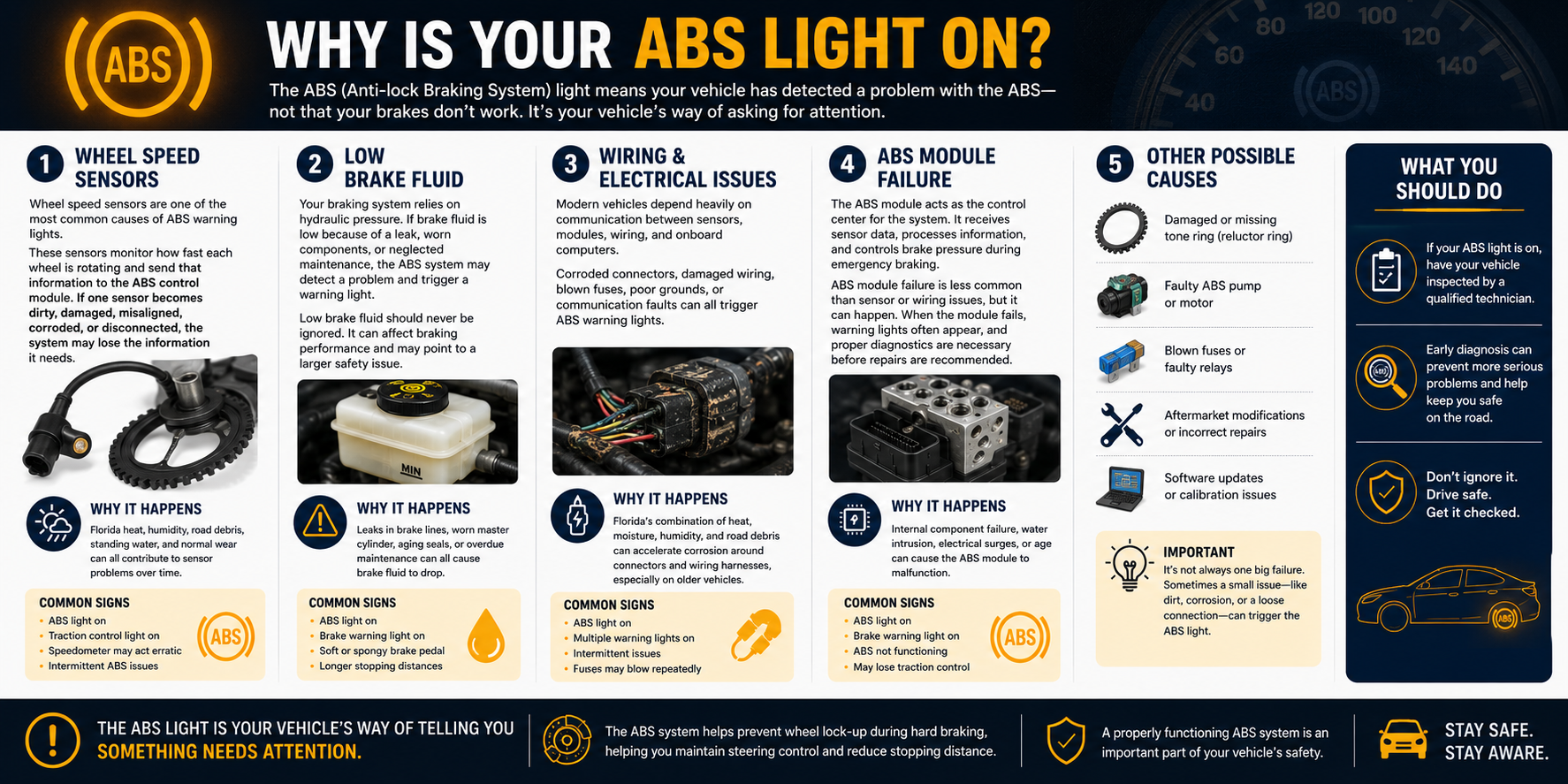
An ABS (Anti-Lock Braking System) light can come on for several reasons, ranging from a simple sensor issue to a more serious brake system problem. Common causes include a faulty wheel speed sensor, damaged sensor wiring, a bad ABS module, low brake fluid, a failing wheel bearing, or problems with the ABS pump. Because the ABS system relies on accurate wheel speed data to prevent skidding during hard braking, even a minor electrical fault can trigger the warning light. A professional diagnostic inspection can identify the exact cause and help restore your vehicle’s braking performance and safety.
What Does the ABS System Do?
ABS stands for Anti-lock Braking System. It helps prevent your wheels from locking up during hard braking.
When you brake suddenly, the ABS system can rapidly pulse brake pressure at individual wheels. This helps the tires continue rotating instead of sliding across the road. That matters because a rolling tire can still steer, while a locked tire is much more likely to skid.
Without ABS, emergency braking on wet pavement, loose gravel, or slick roads can cause a vehicle to lose steering control. With ABS working properly, the driver has a better chance of slowing down while still steering around a hazard.
Modern ABS systems often work alongside:
- Traction control
- Electronic stability control
- Emergency braking assistance
- Advanced driver assistance systems
Because these systems share data, an ABS fault can sometimes affect more than just braking.
What Most Drivers Don’t Know About ABS
Many drivers assume ABS only matters during panic stops.
In reality, the wheel speed sensors used by the ABS system are constantly collecting information while the vehicle is moving. That same data may also be used by traction control, stability control, transmission systems, and other onboard safety features.
That is why a single ABS-related fault can sometimes trigger multiple dashboard lights at the same time.
What Happens When the ABS Light Comes On?
If the ABS light stays illuminated, the vehicle has detected a fault and stored a diagnostic trouble code.
You may not notice any obvious difference during normal driving. However, certain safety features may be disabled or limited.
You may experience:
- Reduced traction control performance
- Disabled stability control
- Longer stopping distances on wet or slippery roads
- Additional warning lights
- Changes in brake pedal feel
Your standard brakes may still work, but the vehicle may not perform as designed during emergency braking or poor road conditions.
Can You Drive With the ABS Light On?
In many cases, yes. If the ABS light is the only warning light on and the vehicle brakes normally, you can usually drive cautiously until you schedule an inspection.
However, you should avoid aggressive driving, hard braking, and wet-road risks as much as possible.
Schedule service immediately if you notice:
- The red brake warning light appears with the ABS light
- Soft or spongy brake pedal
- Grinding or squealing noises
- Reduced braking performance
- Vehicle pulling during braking
- Fluid leaks
- Burning smell near the wheels
- Brake pedal sinking toward the floor
These symptoms may indicate a more serious issue requiring prompt brake repair.
Red Brake Light And ABS Light At Same Time
If the red brake warning light and ABS light come on at the same time, the problem may be more serious than an ABS fault alone and you should pull over and get the car serviced immediately. Do not attempt to drive while both the ABS and red brake light are on. The ABS light generally indicates that the anti-lock braking system has been disabled, while the red brake light can point to issues such as low brake fluid, an engaged parking brake, a hydraulic braking problem, or another fault affecting the primary brake system. When both lights are illuminated, the vehicle may still have some braking ability, but important safety systems—including ABS and potentially electronic brake-force distribution—may not operate correctly. If the brake pedal feels soft, braking performance changes, or the red brake light stays on after confirming the parking brake is released, the vehicle should be inspected before driving further.
Causes of an ABS Warning Light
Faulty Wheel Speed Sensors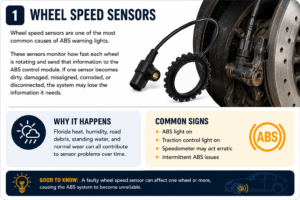
Wheel speed sensors are one of the most common causes of ABS warning lights. These sensors are mounted near each wheel and continuously monitor wheel speed while you drive. The information is sent to the ABS control module, which uses the data to determine when a wheel is beginning to lock up during hard braking. The system can then rapidly adjust brake pressure to help maintain traction and steering control.
Because the ABS system depends on accurate information from all four wheels, even a small problem with a single sensor can trigger the warning light. Sensors can become contaminated by dirt, brake dust, road grime, or metal particles that interfere with their ability to read wheel speed accurately. Physical damage from potholes, road debris, curb impacts, or suspension wear can also affect sensor performance. In some cases, corrosion in electrical connectors or damaged wiring may interrupt communication between the sensor and the ABS module.
On many modern vehicles, the wheel speed sensor works in conjunction with the wheel bearing or hub assembly. As wheel bearings wear, excessive play can create inconsistent sensor readings that cause the ABS system to detect a fault. This is why an ABS light can sometimes be an early warning sign of a developing wheel bearing problem.
Florida’s driving conditions can be especially tough on ABS components. High heat, humidity, frequent rain, standing water, and coastal salt exposure can accelerate corrosion and electrical issues over time. Vehicles that regularly encounter flooded roadways or deep puddles may be more susceptible to sensor and wiring problems as moisture works its way into connectors and harnesses.
When a wheel speed sensor fails or provides inaccurate data, the ABS system may disable itself as a safety precaution. The vehicle’s standard brakes will typically continue to function normally, but anti-lock braking capabilities may be unavailable until the problem is diagnosed and repaired. In many cases, a professional scan tool can quickly identify which wheel is reporting a fault and help pinpoint the source of the problem.
A Sensor Code Does Not Always Mean the Sensor Failed
A wheel speed sensor code does not automatically mean the sensor itself is bad.
The issue could be:
- Damaged wiring
- Corroded connectors
- A damaged tone ring
- A failing wheel bearing
- Electrical communication problems
- Sensor contamination from road debris
This is why professional diagnostics matter. Replacing the sensor without testing the circuit can lead to unnecessary parts replacement.
For warning lights, sensor faults, wiring concerns, and electrical communication problems, Cassels Garage provides vehicle electrical diagnostics and repair for drivers in West Melbourne and surrounding areas.
Low Brake Fluid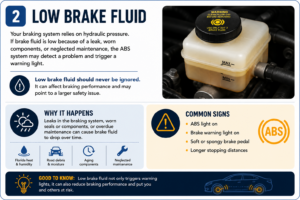
Brake Fluid Does Not Last Forever
Brake fluid absorbs moisture over time. As moisture contamination increases, brake performance can decline, and internal corrosion can develop inside hydraulic brake components.
That is why brake fluid condition should be checked during routine maintenance and brake inspections, not only when a warning light appears.
Damaged Wiring or Electrical Problems 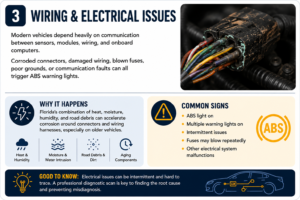
Modern vehicles rely on a network of sensors, control modules, wiring harnesses, and onboard computers that constantly communicate with one another. The ABS system is no exception. Wheel speed sensors, the ABS control module, traction control system, stability control system, and other vehicle electronics must continuously exchange information for the system to operate correctly.
When that communication is interrupted, the ABS warning light may illuminate even if there is no mechanical problem with the brakes themselves. Corroded electrical connectors, damaged wiring, blown fuses, poor ground connections, loose terminals, or faults within the vehicle’s communication network can all prevent the ABS system from receiving the data it needs. In many cases, a small electrical issue can create the same warning light as a failed sensor or ABS component.
Florida’s climate can be particularly hard on automotive electrical systems. High temperatures, humidity, heavy rainfall, standing water, and coastal salt exposure can accelerate corrosion inside connectors and wiring harnesses over time. Road debris and normal vibration can also wear through wiring insulation or damage connections, especially on older vehicles with higher mileage.
Because electrical faults can be difficult to identify without proper testing equipment, diagnosing the exact cause often requires a professional scan tool and electrical inspection. Finding and repairing these issues early can prevent intermittent warning lights, additional electrical problems, and more costly repairs down the road.
Worn Brake Components
In some cases, worn brake pads, damaged rotors, sticking calipers, or hydraulic issues can contribute to ABS-related warnings.
Many drivers assume the ABS light must be an electronic problem. Sometimes it is. But mechanical brake issues can also affect wheel speed readings, braking stability, and system performance.
Routine brake repair and brake service can help catch these issues before they become more expensive.
ABS Module Failure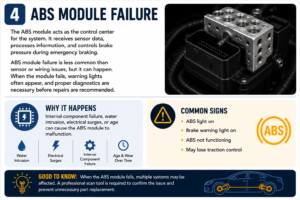
Can Tire Problems Trigger ABS Warning Lights?
Yes, tire problems can sometimes contribute to ABS issues.
Many drivers do not realize that tires, wheel bearings, suspension, steering, and ABS systems are closely connected.
ABS depends on accurate wheel speed data. If one wheel appears to be rotating differently from the others, the system may interpret that as a problem.
This can happen when:
- One tire is replaced while the others are heavily worn
- Incorrect tire sizes are installed
- A temporary spare tire is used
- Tire pressure varies significantly
- Uneven wear changes tire diameter
- A wheel bearing affects sensor readings
This is one reason tire inspections, rotations, and wheel alignments matter for more than tire life alone.
What If the ABS Light Comes On After Recent Repairs?
If the ABS light appears soon after tire replacement, brake service, wheel bearing replacement, suspension repairs, or alignment work, the issue may involve a sensor, connector, or wiring problem near the area that was serviced.
That does not necessarily mean the repair was done incorrectly. Wheel speed sensors and wiring are often located near components that are removed or moved during related repairs.
Tell your technician exactly when the light appeared and what work was recently performed. That information can reduce diagnostic time.
Why Professional Diagnostics Matter
An ABS warning light tells you the system detected a fault. It does not tell you which part failed.
For example, a wheel speed sensor code may be caused by:
- A failed sensor
- Damaged wiring
- Corrosion
- A wheel bearing issue
- A damaged tone ring
- A module communication problem
Clearing the light does not fix the problem. If the underlying fault remains, the light will usually return.
Professional diagnostics allow technicians to retrieve fault codes, inspect live sensor data, test wiring, verify brake system condition, and confirm the actual cause before recommending repairs.
At Cassels Garage, our team performs auto repair and diagnostic services designed to identify the source of the problem rather than guessing.
Take Advantage of Free Vehicle Inspections
One of the best ways to stay ahead of ABS, brake, tire, steering, and suspension problems is to take advantage of free vehicle inspections during routine service visits.
Many safety issues develop gradually. A driver may not notice the early signs, but a technician can often identify them during an inspection.
A free vehicle inspection may include checks for:
- Tire condition
- Uneven tread wear
- Brake pad thickness
- Brake fluid condition
- Suspension wear
- Steering concerns
- Battery condition
- Fluid leaks
- Belt and hose wear
- Warning lights
- Electrical concerns
This matters because ABS problems are not always isolated. A worn wheel bearing can affect wheel speed sensor readings. Uneven tire sizes can confuse the ABS system. Suspension wear can affect tire contact with the road. Brake fluid conditions can affect hydraulic performance.
Cassels Garage offers full-service maintenance and free digital inspections, oil changes, brake checks, tire service, steering and suspension inspections, and diagnostics so drivers can address small problems before they become larger repairs.
Preventive Maintenance Helps Prevent Warning Lights
Many ABS-related problems develop over time.
Regular maintenance can help catch issues before warning lights appear, including:
- Brake inspections
- Fluid checks
- Tire rotations
- Wheel alignments
- Suspension inspections
- Electrical checks
- Routine oil change services
Even services that seem unrelated can support brake and safety system performance.
For example, worn suspension components can reduce tire contact with the road. Uneven tire wear can affect wheel speed readings. Electrical issues can interfere with sensor communication. Low brake fluid can affect hydraulic performance.
Cassels Garage provides steering and suspension repair in addition to brake service, diagnostics, tires, and maintenance, allowing technicians to evaluate how multiple systems work together.
Your Local Alternative to the Dealership
Many drivers assume they need to visit the dealership for ABS warning lights, brake repairs, tire services, electrical diagnostics, and maintenance.
In reality, an experienced independent repair facility can often perform many of the same diagnostic and repair services while providing clearer communication, honest recommendations, and competitive pricing.
At Cassels Garage & Tire Service, we have helped drivers throughout West Melbourne, Melbourne, Palm Bay, and the surrounding Space Coast communities maintain and repair their vehicles for decades.
Our technicians take the time to explain what your vehicle needs, why it matters, and which repairs should be prioritized.